Unlike most medical procedures, dialysis isn’t a one-time expense — it’s a recurring commitment that can stretch across months or years. That single difference changes how
dialysis cost in Bangalore should be understood: a per-session number alone doesn’t tell you much until it’s multiplied by how often you’ll need treatment and added up over a month.
This guide breaks down exactly that — cost by dialysis type, what a realistic monthly bill looks like, how insurance and government schemes factor in, and what to look for in a center when you’ll be visiting regularly rather than just once. Blue Bliss Hospital, a Centre of Excellence in Nephrology, Urology & Kidney Transplant Care in Seshadripuram, Bangalore, is referenced throughout as an example of how transparent, sustainable dialysis care is structured.
What Determines Kidney Dialysis Treatment Cost in Bangalore?
Before looking at numbers, it’s worth understanding what actually drives
kidney dialysis treatment cost in Bangalore, since the same diagnosis can lead to very different monthly bills depending on how these factors line up.
The type of dialysis is the biggest factor — hemodialysis and peritoneal dialysis have fundamentally different cost structures, which we’ll break down separately below. Session frequency matters just as much: most hemodialysis patients need 2 to 3 sessions a week, so a small difference in per-session price gets multiplied many times over a month. The setting also plays a role — a dedicated dialysis center often prices differently than a hospital-based unit, partly due to differences in overhead and available emergency backup.
Beyond these, consumables like dialyzers and tubing, vascular access type (an AV fistula, graft, or catheter each carry different costs), doctor consultation fees, and any complications requiring extra intervention all add to the total. This is why dialysis cost estimates are best understood as a monthly range rather than a single session price — the session number alone rarely reflects what a patient actually pays over time.
Hemodialysis Cost in Bangalore
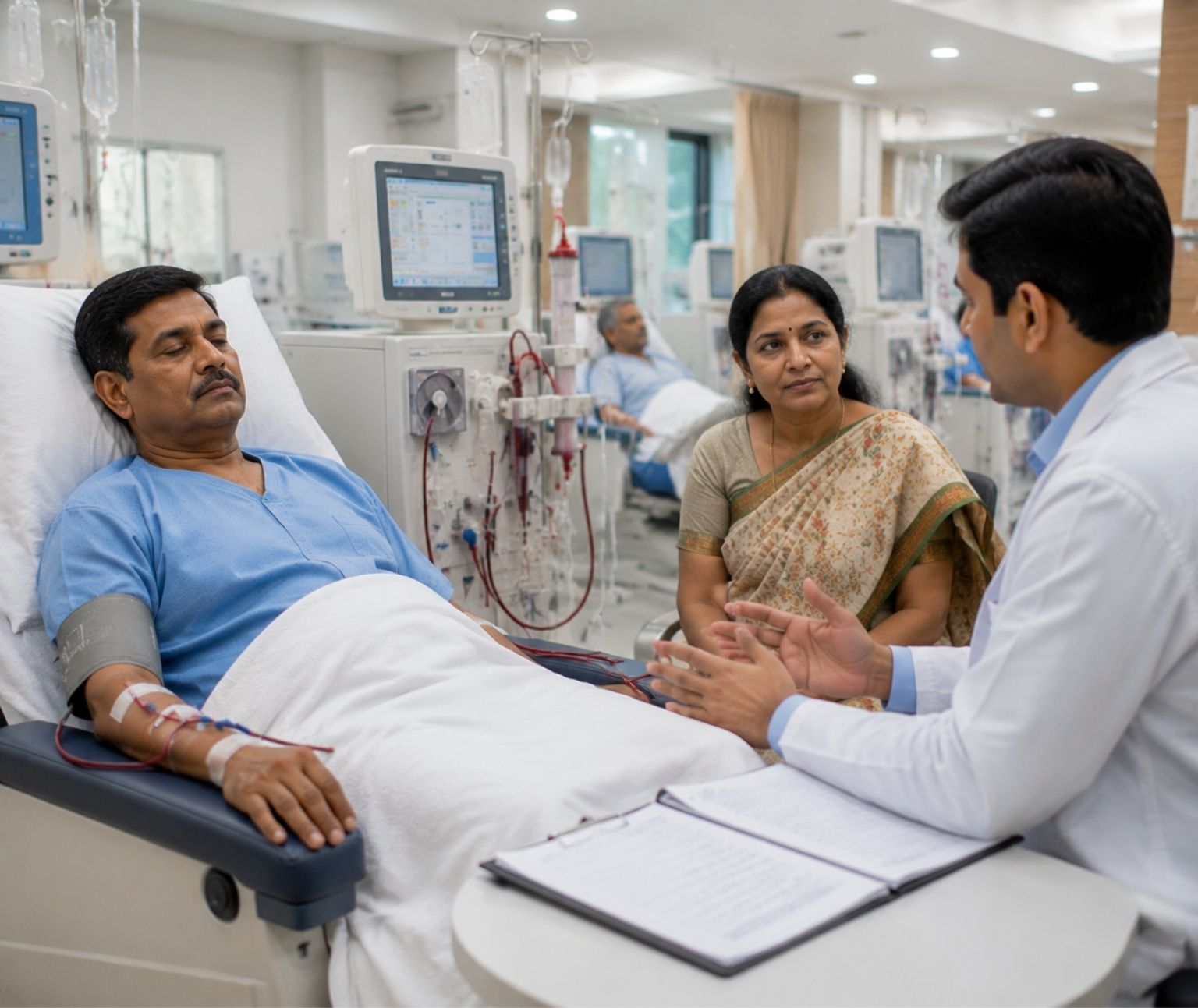
Hemodialysis is the most common form of dialysis, where blood is drawn out, filtered through an external machine, and returned to the body — typically done at a hospital or dedicated dialysis center rather than at home. Because of this,
hemodialysis cost in Bangalore is usually billed per session, generally ranging from around ₹1,500 to ₹5,000 depending on the facility, the type of vascular access used, and whether the session takes place at a standalone dialysis center or a hospital-based unit.
The number that matters most for budgeting, though, is the monthly total — since most patients require 2 to 3 sessions a week, not just one. At that frequency, monthly hemodialysis costs typically fall somewhere between ₹15,000 and ₹40,000, before adding consultation fees, lab tests, or medication.
| Frequency |
Per-Session Cost |
Estimated Monthly Cost |
| 2 sessions/week |
₹1,500 – ₹5,000 |
₹12,000 – ₹40,000 |
| 3 sessions/week |
₹1,500 – ₹5,000 |
₹18,000 – ₹60,000 |
(Ranges reflect commonly reported figures across Bangalore facilities; actual cost depends on individual treatment plan and facility.)
It’s also worth factoring in the one-time cost of creating vascular access — an AV fistula is generally the least expensive option, while a catheter-based access point tends to cost more. Since this is a recurring treatment, even small differences in per-session pricing compound significantly over months, which is why comparing monthly totals, not just session rates, is the more useful way to evaluate different centers.
Peritoneal Dialysis Cost in Bangalore
Peritoneal dialysis (PD) works differently from hemodialysis — instead of an external machine, a cleansing fluid is introduced into the abdomen through a catheter, absorbs waste, and is drained out, a process that can largely be done at home rather than requiring frequent hospital visits. This fundamentally changes the shape of
peritoneal dialysis cost in Bangalore: instead of paying primarily for hospital sessions, the ongoing cost is driven by consumables — PD fluid bags and supplies delivered regularly to support daily exchanges.
Monthly peritoneal dialysis costs in Bangalore typically range from around ₹20,000 to ₹40,000 for standard continuous ambulatory peritoneal dialysis (CAPD), and can run higher, sometimes up to ₹1,00,000, for automated peritoneal dialysis (APD), which uses a machine to cycle fluid overnight and generally costs more due to the equipment involved. There’s also a one-time cost for the catheter placement procedure itself, which is a minor surgery done before starting PD.
PD isn’t automatically the “cheaper” option just because it avoids frequent hospital visits — it depends on the specific type chosen and how consumables are priced. It’s also not suitable for every patient, since it requires a level of home hygiene, training, and sometimes caregiver support to manage exchanges correctly. Whether PD or hemodialysis is the better fit is ultimately a clinical decision made with a nephrologist, with cost being one factor among several, including lifestyle, mobility, and how much day-to-day involvement a patient can manage.
Hemodialysis vs. Peritoneal Dialysis: Cost Comparison
Placed side by side, the two options don’t just differ in price — they differ in
how that price shows up over time, which matters as much as the total figure itself.
| Factor |
Hemodialysis |
Peritoneal Dialysis |
| Setting |
Hospital / dialysis center |
Primarily home-based |
| Typical monthly cost |
₹15,000 – ₹40,000+ |
₹20,000 – ₹40,000+ (up to ₹1,00,000 for APD) |
| Frequency |
2–3 sessions/week |
Daily exchanges |
| Main cost driver |
Per-session facility fee |
Ongoing consumables/supplies |
| Travel requirement |
High (regular hospital visits) |
Low (mostly home-based) |
Hemodialysis costs are generally more predictable since they’re billed per session at a known rate, but the frequent hospital visits add travel time and cost that’s easy to underestimate. Peritoneal dialysis reduces travel dramatically but shifts the ongoing cost to recurring supply deliveries, which can vary more depending on the specific PD type prescribed. Neither option is universally cheaper — the right comparison depends on a patient’s specific treatment plan, lifestyle, and how the two cost structures play out over months rather than any single number.
Does Insurance Cover Dialysis Cost in Bangalore?
Because dialysis is ongoing rather than a one-time event, insurance coverage plays an outsized role in what a patient actually ends up paying, making it one of the most important sections in this guide. Most standard health insurance policies in India do cover dialysis as part of chronic kidney disease management, but recurring treatments like this can hit annual policy caps faster than a one-time surgery would — a caveat worth understanding before treatment begins, not after.
Beyond private insurance, government support is also relevant here. The Pradhan Mantri National Dialysis Programme (PMNDP) provides subsidized or free hemodialysis at government facilities across districts, and Karnataka has recently extended similar support to peritoneal dialysis through its Ayushman Bharat–Arogya Karnataka initiative, aimed specifically at reducing the financial burden of long-term dialysis care. Eligibility and access vary, so it’s worth checking current scheme details directly with a hospital’s billing or patient support team.
For private treatment, cashless arrangements are generally smoother for recurring care like dialysis, since reimbursement claims for multiple sessions each month can become an administrative burden over time. Blue Bliss Hospital accepts a wide range of insurance providers and is built around transparent billing, which makes it worth confirming coverage details, including how annual caps apply to recurring treatment, before starting a long-term dialysis plan.
Additional Costs to Factor In
The per-session or monthly dialysis fee is rarely the complete financial picture, and the smaller recurring costs around it are easy to underestimate until they add up.
Routine lab tests and monthly consultations to monitor mineral levels, blood counts, and overall kidney function typically add a few thousand rupees a month. Medications are often a significant addition too — most dialysis patients need supporting drugs like EPO injections for anemia and blood pressure medication, since dialysis manages waste filtration but doesn’t fully replace every kidney function.
Transport is a cost that’s frequently overlooked, especially for hemodialysis patients making 2 to 3 trips a week to a center — over months, this adds up meaningfully, particularly for patients traveling from outside the immediate area. Occasional costs like vascular access maintenance, or in rare cases addressing access-related complications, should also be budgeted for as part of the realistic total, rather than treating the base session or monthly fee as the whole story.
How to Manage Long-Term Dialysis Costs
Because dialysis is a sustained commitment, small decisions early on can meaningfully affect total cost over months and years, making a few practical habits worth adopting from the start.
Choosing a center close to home is one of the most underrated cost-saving decisions for hemodialysis patients specifically, given how often travel is required — a slightly higher per-session fee at a nearby center can still work out cheaper overall than a lower-priced center that requires significant travel time and expense several times a week. Understanding insurance caps early, rather than discovering them mid-treatment, also helps with planning; ask specifically how recurring dialysis claims are treated against your policy’s annual limit.
It’s also worth asking centers directly about package or bundled pricing for regular sessions, since many facilities offer more predictable monthly rates for patients on a fixed schedule rather than pure pay-per-session pricing. Finally, checking eligibility for government schemes like PMNDP or Karnataka’s PD initiative is worth doing early, since these programs are specifically designed to reduce the financial burden of exactly this kind of long-term, recurring treatment.
Best Dialysis Center in Bangalore: What to Look For
Because dialysis means returning to the same facility multiple times a week, sometimes for years, the criteria for choosing the
best dialysis center in Bangalore go beyond just comparing prices — center quality directly affects both safety and long-term cost, since complications from poor care can add expensive setbacks.
Hygiene standards and machine maintenance protocols should be non-negotiable, given how frequently the same equipment is used across patients. Staff-to-patient ratio matters too, since dialysis requires continuous monitoring for complications like blood pressure drops during a session — a center that’s understaffed relative to its patient volume is a real risk factor, not just an inconvenience. The number of dialysis stations available also affects practical things like scheduling flexibility and wait times, which matter more here than for a one-time procedure given how often patients return.
Blue Bliss Hospital’s dialysis unit manages over 800 treatments every month, a scale that reflects both established infrastructure and a team experienced in handling high patient volume without compromising individual monitoring. For a treatment this frequent, that kind of sustained operational experience is often a more meaningful signal of quality than marketing claims alone.
Why Choose Blue Bliss Hospital for Dialysis Care
Bringing cost transparency, center quality, and insurance support together, Blue Bliss Hospital is structured around the reality that dialysis is a long-term relationship, not a single visit. The hospital offers both hemodialysis and infrastructure to support ongoing kidney disease management, backed by in-house 24/7 diagnostics that reduce the need for external lab visits between sessions.
Since its establishment in 2005, Blue Bliss has treated over 5 lakh patients, with its dialysis unit alone handling over 800 treatments monthly under a team of 50+ expert doctors and a dedicated nephrology practice led by Dr. V.R. Raju, Chief Nephrologist & CEO. Combined with wide insurance acceptance, flexible payment options, and round-the-clock emergency backup, the hospital is built to support dialysis patients through the full duration of long-term treatment — not just a single session.
Frequently Asked Questions
- How much does dialysis cost per session in Bangalore?
Hemodialysis typically costs between ₹1,500 and ₹5,000 per session in Bangalore, depending on the facility and type of vascular access used, while peritoneal dialysis costs are usually calculated monthly rather than per session.
- What is the monthly cost of hemodialysis in Bangalore?
For patients undergoing 2 to 3 sessions a week, monthly hemodialysis costs typically range from ₹15,000 to ₹40,000, before adding consultation fees, lab tests, and medication.
- Is peritoneal dialysis cheaper than hemodialysis?
Not necessarily — peritoneal dialysis reduces hospital visits and travel costs but shifts the expense to ongoing supplies, with monthly costs generally similar to or sometimes higher than hemodialysis, depending on the specific PD type prescribed.
- Does insurance cover dialysis treatment?
Most standard health insurance policies cover dialysis as part of chronic kidney disease management, though recurring sessions can reach annual policy caps faster than a one-time procedure, so it’s important to confirm limits in advance.
Ready to Take the Next Step?
Understanding your realistic monthly dialysis cost starts with a direct consultation rather than a general estimate. Blue Bliss Hospital’s nephrology team, led by Dr. V.R. Raju, can walk you through the right dialysis type for your condition along with a transparent cost breakdown and insurance guidance.
Book an Appointment with Blue Bliss Hospital →