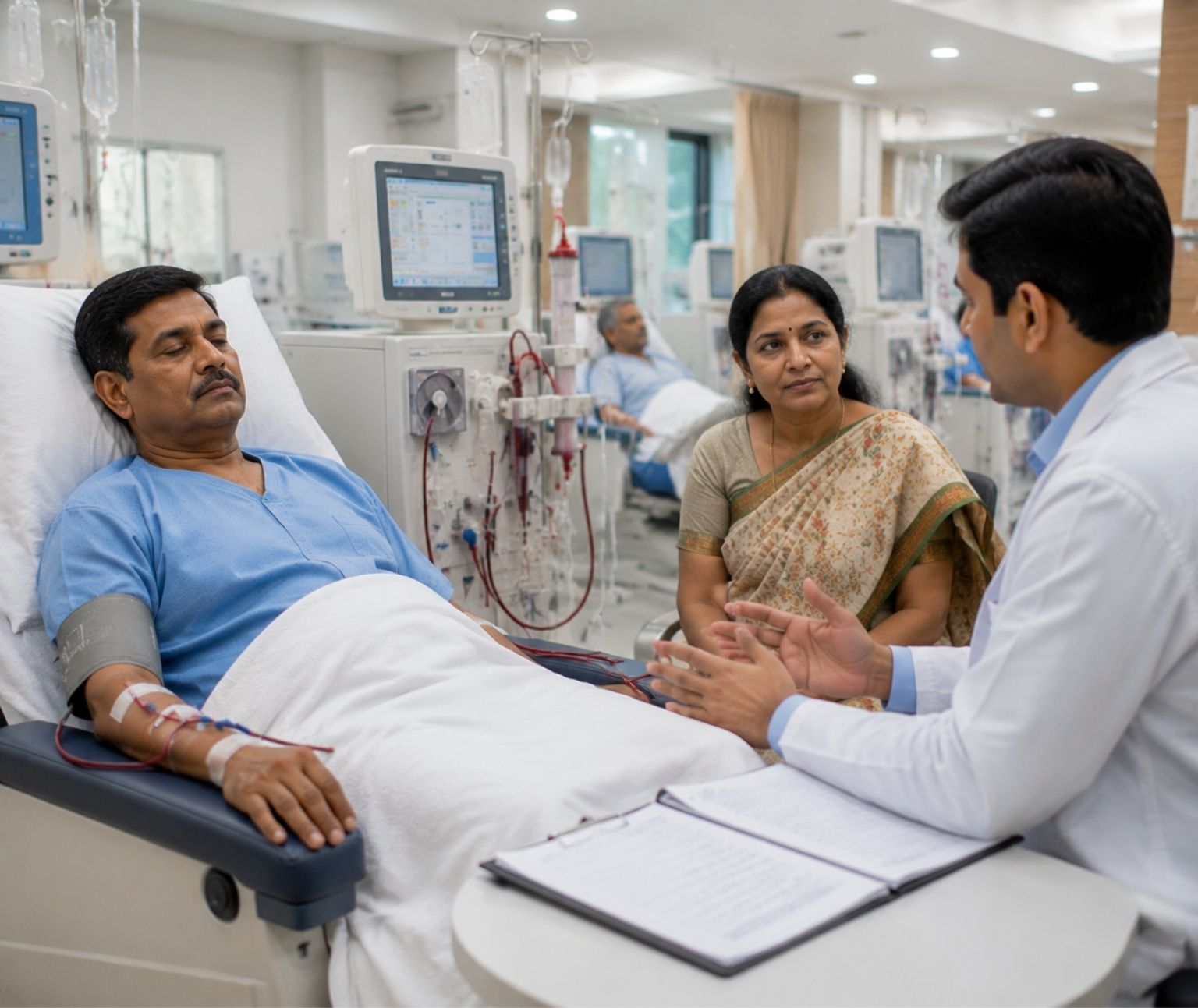
Kidney disease doesn’t ask you to make one decision. It asks you to make dozens, spread across years — sometimes decades. There’s the hospital that catches the first diagnosis. The one that manages dialysis, if it comes to that. The one whose hands you trust with a transplant. And the one you’ll return to, year after year, long after the surgery is behind you. Few medical conditions demand this kind of sustained relationship with a single institution — which is exactly what makes finding the
best kidney hospital in Bangalore a fundamentally different search than choosing a clinic for a one-time problem.
This guide is built to make that search easier. Instead of leaning on star ratings, word-of-mouth, or proximity to home, we’ll walk through the specific factors that actually predict good outcomes — the things a hospital either has in place or doesn’t. Along the way, we’ll use Blue Bliss Hospital, a Centre of Excellence in Nephrology, Urology & Kidney Transplant Care in Seshadripuram, Bangalore, as a working example of what these criteria look like when a hospital gets them right.
Why Choosing the Right Kidney Hospital Matters
Kidney conditions are rarely a single-visit problem. Whether it’s chronic kidney disease (CKD), long-term dialysis, or a transplant, the relationship with a hospital often stretches across years, sometimes decades. That’s a fundamentally different commitment than choosing a hospital for, say, a minor surgery — the hospital you pick becomes your default point of contact for lab work, medication reviews, emergency complications, and long-term monitoring.
Choosing the wrong hospital doesn’t just risk a bad single experience — it compounds. Inconsistent care between visits, having to repeat diagnostics because records aren’t managed well, or discovering too late that a hospital doesn’t have in-house transplant or dialysis capability can all mean delays that matter for a condition where timing genuinely affects outcomes. This is exactly why the criteria in the next section matter more here than they would for most other medical decisions — they’re not “nice to have,” they’re what determines whether your care stays continuous or gets fragmented.
Key Factors to Look for in the Best Kidney Hospital in Bangalore
When evaluating the
best kidney hospital in Bangalore, a handful of factors consistently separate strong programs from average ones, and they’re worth checking before you commit to a hospital for ongoing care.
The first is whether nephrology and urology operate as one coordinated team rather than separate departments that hand patients back and forth. Kidney care frequently needs both specialties — nephrology for medical management and urology for surgical intervention — and a hospital where both are led together tends to move faster on decisions, since there’s no delay waiting for cross-department referrals. The second is infrastructure: 24/7 ICU and emergency backup, in-house diagnostics that don’t require sending samples elsewhere, and a functioning blood bank matter enormously for a condition where complications can arise outside normal hours.
Beyond infrastructure, look at the hospital’s actual transplant credentials — does it run both living and deceased donor programs, and does it have a track record it’s willing to share? Insurance support and billing transparency are also worth checking early, since kidney treatment is a long-term financial commitment, not a one-time expense. And finally, patient volume and years in operation act as a practical trust signal — a hospital that has treated a large number of kidney patients over many years has typically refined its protocols in ways a newer or lower-volume center hasn’t had the chance to.
Top Kidney Hospitals in Bangalore: What to Compare
Rather than chasing a ranked list, it’s more useful to know what to actually compare when researching
top kidney hospitals in Bangalore — since “best” looks different depending on whether you need routine nephrology care, dialysis, or a transplant.
Start with specialties offered under one roof. A hospital that combines nephrology, urology, cardiology, and critical care means fewer referrals to outside facilities, which matters for kidney patients who often have overlapping conditions like diabetes or hypertension. Next, compare dialysis capacity — the number of stations, monthly treatment volume, and hygiene protocols — since dialysis patients typically visit multiple times a week and small inefficiencies compound quickly over months of visits.
Also compare each hospital’s transplant program specifically: whether they publish or share outcome data, how experienced their surgical team is, and whether their post-transplant follow-up is structured or ad hoc. Accreditation and how long the hospital has operated in the city are also worth weighing, since Bangalore has both long-established nephro-urology centers and newer general hospitals that have added kidney care more recently. A simple framework — specialties, dialysis capacity, transplant track record, accreditation, and location — gives you an apples-to-apples way to compare any two hospitals on your shortlist.
Best Kidney Transplant Hospital in Bangalore: What Sets It Apart
Transplant care is a narrower, higher-stakes category than general kidney treatment, so the bar for a
best kidney transplant hospital in Bangalore is naturally higher than for general nephrology care. The surgical team’s experience matters most here — a kidney transplant requires precision in both the urological surgery and the nephrology-led donor evaluation and immunosuppression planning that happens before and after.
Blue Bliss Hospital’s transplant program is anchored by Dr. L.N. Raju, Chief Urologist & Chairman, and Dr. V.R. Raju, Chief Nephrologist & CEO, both with over two decades of combined experience leading the hospital’s urology and nephrology practice. Having both specialties led at the senior level, rather than split across disconnected departments, reduces the handoff delays that can otherwise slow down time-sensitive decisions during donor workup or post-surgical recovery.
Beyond the surgeons themselves, a strong transplant hospital needs the infrastructure to support both living and deceased donor transplants, along with structured long-term follow-up rather than treating surgery as a one-time event. Blue Bliss’s supporting team of 30+ specialists across 15+ disciplines, combined with round-the-clock ICU, in-house diagnostics, and a dedicated blood bank, is built around exactly this — managing the full arc of transplant care from first consultation through years of post-transplant monitoring, not just the operation itself.
Best Dialysis Center in Bangalore: What to Check
Not every kidney patient is on the transplant track — many rely on dialysis as ongoing, long-term treatment, which makes the
best dialysis center in Bangalore its own separate decision, deserving its own checklist rather than being treated as an afterthought to transplant care.
Because dialysis typically means multiple sessions a week, small differences in quality compound fast. Check the hygiene standards and maintenance protocols for dialysis machines, the number of dialysis stations available (which affects wait times and scheduling flexibility), and the staff-to-patient ratio during sessions, since dialysis requires continuous monitoring for complications like blood pressure drops. Emergency backup during sessions is non-negotiable — a center should have immediate access to physicians and critical care support if something goes wrong mid-treatment, not just administrative staff on-site.
Blue Bliss Hospital’s dialysis unit handles over 800 treatments every month, a scale that reflects both established infrastructure and a team accustomed to managing high patient volume without compromising individual attention. For patients choosing a long-term dialysis provider, this kind of sustained volume is often a more meaningful signal than marketing claims, since it shows the center has operated at scale over time rather than recently expanding into dialysis care.
Kidney Transplant Cost in Bangalore
Cost is often the question patients hesitate to ask upfront, but understanding
kidney transplant cost in Bangalore early is part of choosing the right hospital, not a separate conversation to have later. Total cost typically depends on several variables: whether the donor is living or deceased, the length of hospital stay, the type and duration of post-operative immunosuppressant medication, and whether the hospital’s insurance network covers part of the treatment.
Because these variables shift the total significantly from patient to patient, it’s more useful to think in terms of what drives the number up or down rather than fixating on a single published figure, which can also go outdated quickly. A hospital that’s transparent about this breakdown before treatment begins — rather than presenting one lump estimate — is generally a better sign of trustworthy billing practices.
Blue Bliss Hospital positions itself around affordable, transparent multispecialty care and accepts a wide range of insurance providers, with flexible payment options built specifically to make long-term kidney treatment more manageable. For an exact estimate based on your specific case — donor type, health status, and insurance coverage — a direct consultation with the hospital’s nephrology team will give a far more accurate number than any general range.
Questions to Ask Before Choosing a Kidney Hospital
Having a short list of direct questions ready before your first consultation can save months of trial and error later. Here’s a practical checklist to bring with you:
- What is your hospital’s kidney transplant success rate, and do you track it over 5 and 10 years?
- Do you have an integrated nephrology and urology team, or are they separate departments?
- What is your dialysis center’s monthly treatment volume and staff-to-patient ratio?
- Do you support both living and deceased donor transplant programs?
- What does the total treatment cost typically include, and what could add to it?
- Is 24/7 ICU and emergency care available on-site, not just during regular hours?
- Which insurance providers do you accept, and what payment flexibility is available?
Asking these questions directly, rather than relying only on a hospital’s marketing material, gives you a much clearer sense of whether a hospital’s actual operations match its reputation — and it’s a habit worth carrying into every major kidney-care decision, not just the first one.
Why Blue Bliss Hospital Fits This Checklist
Mapped against the criteria above, Blue Bliss Hospital’s structure was built around exactly these gaps. Its nephrology and urology departments operate under unified senior leadership — Dr. V.R. Raju and Dr. L.N. Raju respectively — rather than as siloed teams, which addresses the coordination concern that often slows down kidney care elsewhere. Its infrastructure checks the operational boxes too: 24/7 ICU and emergency services, in-house 24/7 diagnostics, a dedicated blood bank, and an on-site pharmacy, all under one roof in Seshadripuram.
On scale and trust signals, the hospital has treated over 5 lakh patients and completed more than 10,000 successful surgeries since it was established in 2005, supported by a team of 50+ expert doctors and 30+ specialists across 15+ disciplines. Combined with its 800+ monthly dialysis treatments and its focus on affordable, insurance-friendly billing, Blue Bliss represents the kind of multispecialty, criteria-driven kidney care this guide has walked through — proof that “best” isn’t a marketing label, but something you can actually verify against a checklist.
Frequently Asked Questions
-
What is the best kidney hospital in Bangalore?
The best choice depends on integrated nephrology-urology care, 24/7 emergency and ICU infrastructure, dialysis capacity, and a proven transplant track record. Hospitals like Blue Bliss Hospital in Seshadripuram combine all of these under one roof.
- What should I check before choosing a kidney transplant hospital?
Check the surgical team’s transplant experience, whether both living and deceased donor programs are available, post-transplant follow-up structure, and transparent cost and insurance policies.
- How much does kidney transplant cost in Bangalore?
Cost varies based on donor type, hospital stay duration, medication needs, and insurance coverage. It’s best to get a personalized estimate through a direct consultation rather than relying on a single general figure.
- What is the best dialysis center in Bangalore?
Look for a center with a strong monthly treatment volume, proper staff-to-patient ratios, strict hygiene protocols, and immediate emergency backup during sessions. Blue Bliss Hospital’s dialysis unit manages over 800 treatments monthly.
Ready to Take the Next Step?
Choosing a kidney hospital isn’t a decision to make on reputation alone — it’s worth verifying against the criteria in this guide directly with the hospital’s team. Blue Bliss Hospital’s nephrology and urology specialists, led by Dr. V.R. Raju and Dr. L.N. Raju, are available for a consultation to walk through your specific situation.
Book an Appointment with Blue Bliss Hospital →